

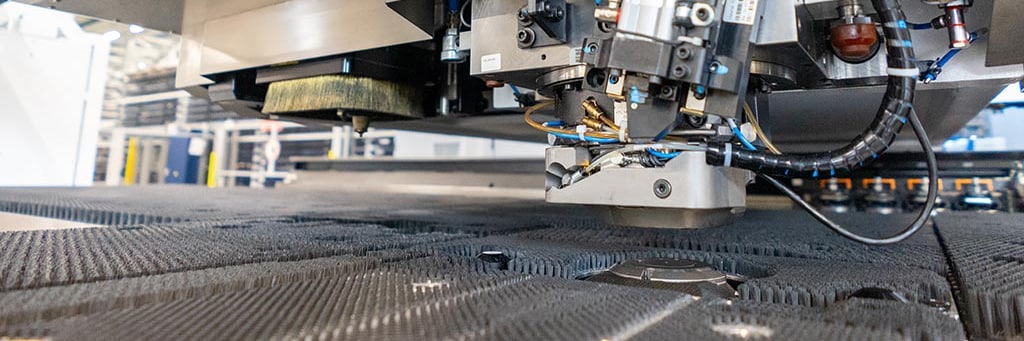
What is a CNC machine?
A CNC machine is a computer-controlled production machine. CNC stands for Computer Numerically Controlled. We can distinguish different degrees of automation: automation of (1) a single operation, (2) a product with multiple operations, and (3) a series of products, each with one or more processing steps, including the supply and removal of products.
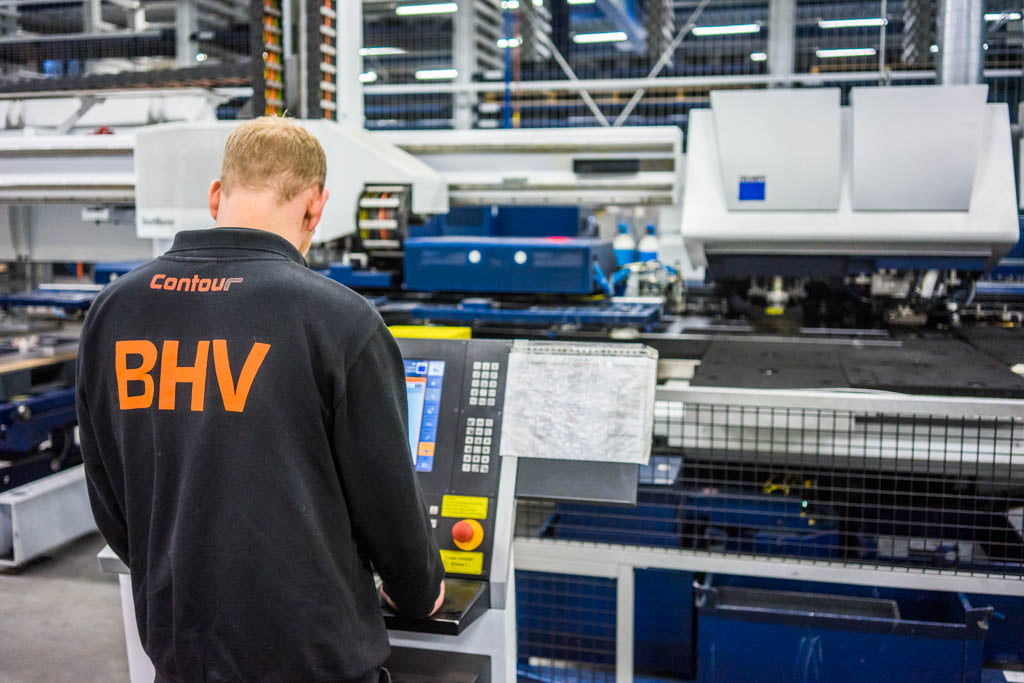
Degrees of automation
Single NC operations
In the simplest form of automation, (1) a single operation can be set parametrically, for example by entering a single cutting length on a numerical console on a band saw. When the operation starts, the machine then saws the tube to the fixed set length. We call this variant NC control, numerical control. Because it involves a single parameter, a computer is often not needed to complete the operation.
Consecutive CNC processing steps
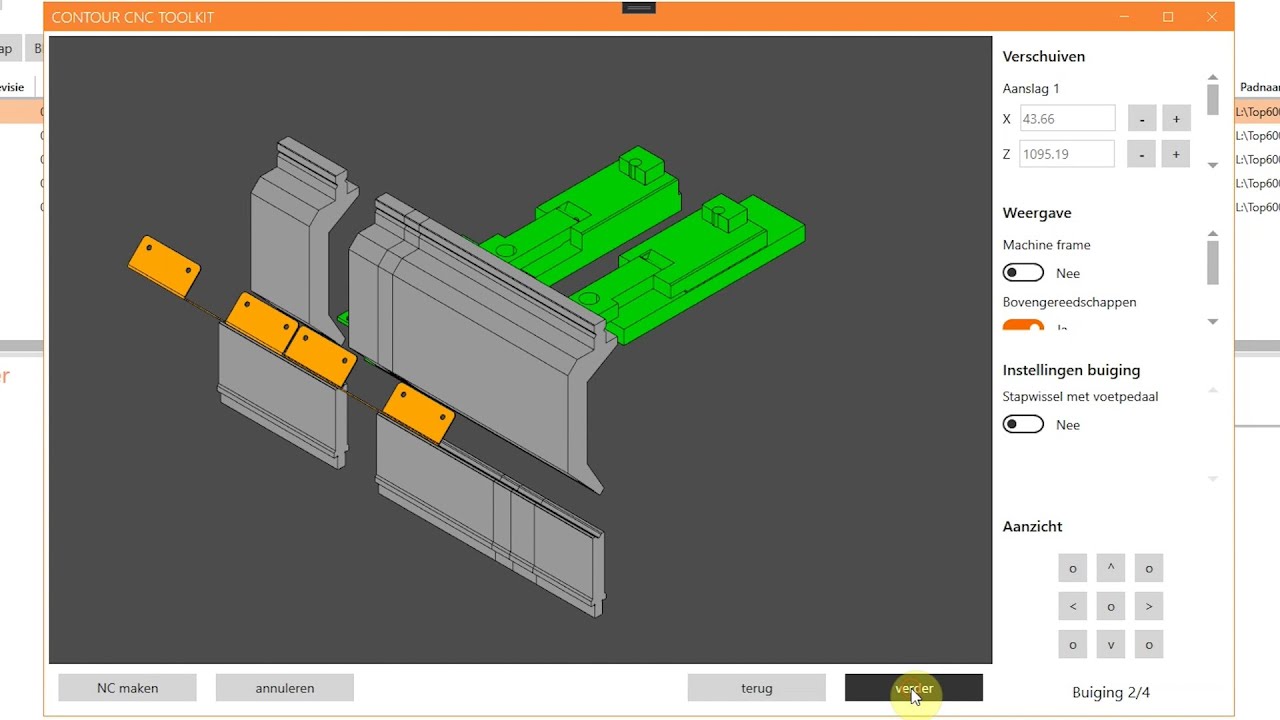
In the second degree of automation, a machine can perform (2) consecutive processing steps. An example is a press brake on which a cycle of several consecutive bending angles is started for each product. For each bending angle, several parameters are defined in the CNC program, such as bending angle, pressing force, and position of the back gauges. By running through the program, the press brake can automatically set each consecutive bend during press brake bending. From this level of automation, programs are typically stored for reuse. If the same product has to be produced again later, the ready-made program can be reused.
CNC including material handling
In the third degree of automation, (3) a processing cycle including material handling can be performed. In this variant, a robot, for example, handles the supply of an unprocessed product and the removal of the processed product. In this way the CNC machine can produce a production batch autonomously. An example of a CNC machine in the third degree of automation is a punch-laser combination or flatbed laser with a connected automatic sheet metal storage system. With the help of the automation, the machine can laser cut several sheets autonomously.
FMS line
We speak of an FMS line when a CNC machine with the highest degree of automation is linked to a storage system for the supply and removal of material, and is also able to change the tooling needed for the various products automatically.
FMS stands for Flexible Manufacturing Solution. An FMS line can produce small series of varying products fully automatically. This makes it a flexible production system. The system can produce in exactly the order the planning asks for. Twenty-four hours a day, without the flexibility of the system being limited by the need for a CNC operator in the night shift to change the tooling at night.
Basic components
The three basic components that make a machine CNC controlled are: (1) The CNC control itself, for example a touchscreen with computer control and associated I/O such as a foot pedal or keyboard. (2) The actuators that this control drives. By actuators we mean electric motors, hydraulics, or pneumatics that set the machine in motion. And (3) sensors that report the state of the machine back (for example the current Y coordinate of the upper beam of a press brake) or are part of a safety circuit to prevent accidents (such as a light curtain).
The combination of these components allows a CNC machine to produce under computer control and in a safe manner.
A CNC machine can therefore be any machine that has these components. There are too many different types of CNC machines to list. Nevertheless, some examples: laser cutting machines, punching machines, press brakes, pem inserters, lathes and milling machines, plate rolls, spot welders, stud welders, coordinate drilling machines, and welding robots.