

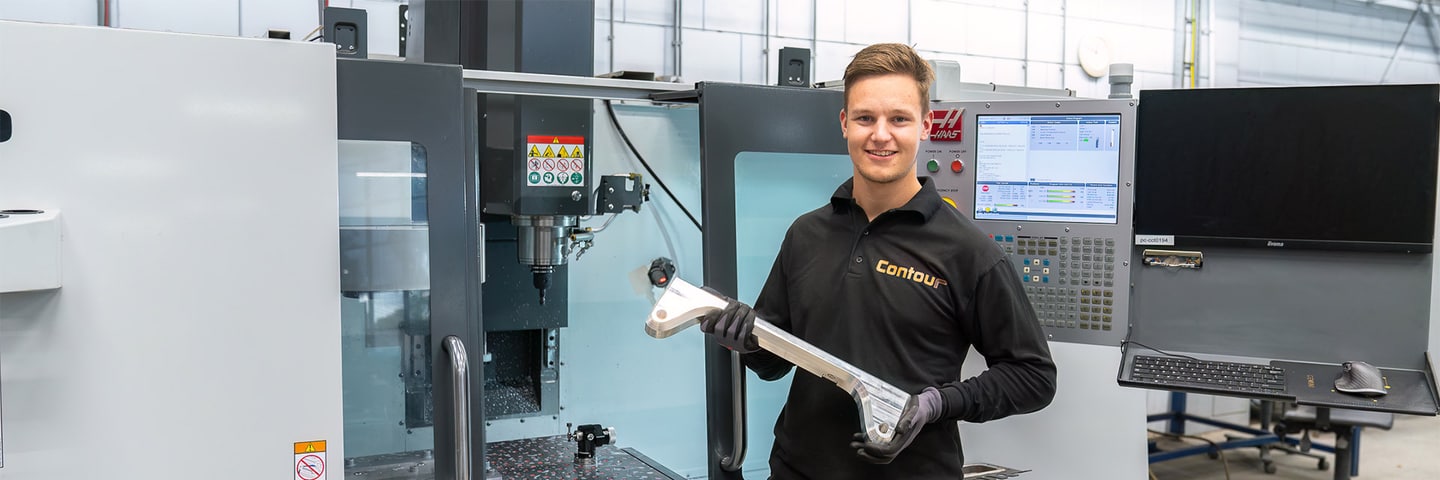
Milling
Sheet metal is often the basis of many different products. It can be produced in several ways, such as metal punching, laser cutting, or milling. In this article we look more closely at how milling is used in the production of sheet metal parts, and at its advantages and applications.
Why milling?
Milling sheet metal offers several advantages over other operations that can be used to add holes, profiles, or reference surfaces to sheet metal.
- Freedom of shape: Complex shapes and structures can be created. Most punching and laser machines are well suited to producing right-angled holes and contours. A milling cutter can accurately apply any desired pattern to the cut edge or to the surface of sheet metal. Examples are a chamfer and a countersunk hole.
- Accuracy and positioning: When high demands are placed on the position of holes or surfaces in the sheet metal, it is sometimes useful to make those holes or surfaces with a CNC milling machine. Normally we make holes in flat sheet metal, using a laser cutting machine or a punch. The sheet metal then undergoes further operations such as welding and press brake bending. Each of these operations can have a small effect on the position of the hole. With a CNC milling machine it is also possible to make the hole after these operations.
- Suitable for different materials: Milling can be applied to many types of material, from standard structural steel to high-strength steel, wear-resistant steel, stainless steel, and aluminum.
- Efficient and productive: CNC milling machines can produce large runs automatically with very high accuracy.
Milling sheet metal
These are a number of specific applications where milling sheet metal adds value compared to laser cutting or punching contours or holes.
- Slots: Milling is extremely suitable for making accurately positioned slots in sheet metal, which can later serve as slots for bolts or as mounting holes for other components.
- Drilling holes: With a CNC milling machine, holes can be drilled in sheet metal easily and accurately.
- Fits: A milling cutter can be used to make precise fits in the sheet metal.
- Tapped holes: The milling machine is able to cut a thread in a hole.
- Flattening products: Milling can be used to make the sheet metal flat, which allows a better flatness tolerance to be achieved.
- Weld edges: Milling can also be used to give the sheet metal a weld edge.
Are you looking for a supplier of sheet metal with a milling operation? Then contact us and request a quote right away.
+31 (0)543 54 67 89 Request a quote
What is milling?
Milling is a machining process in which material is removed by a rotating movement of the tool, the milling cutter. The cutter rotates at high speed and removes material by shaving off thin layers.
During milling, chips are removed, but heat is also produced. Sufficient and correct cooling is therefore important to regulate the temperature and to protect both the material and the cutter. With metals, special coolants are often used to promote cooling and to lubricate the tool and material.