

Stud welding
Stud welding is a fastening technique that we use to weld metal studs, such as threaded rods, onto sheet metal. It is a simple, fast, and cost-effective method and can be used on various materials. The technique is mainly used in the production of sheet metal housings for equipment building.
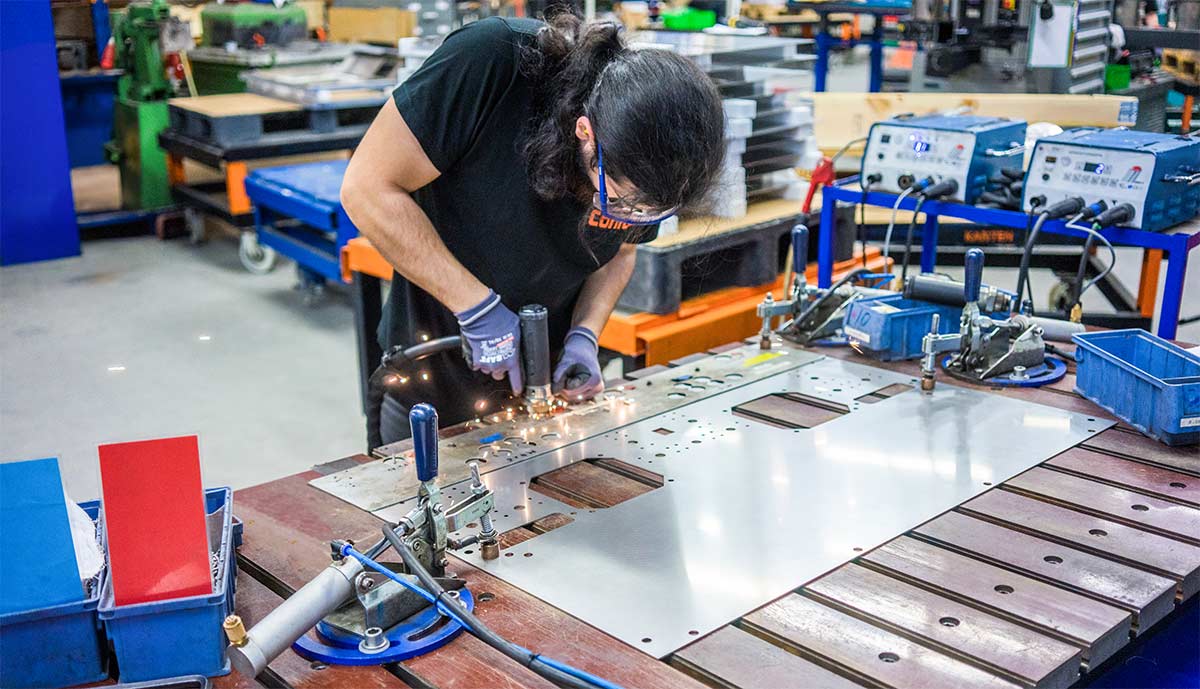
Contour has several stud welding machines and a special stud welding table with pneumatic grounding clamps. We work with stud welding jigs to secure the accurate positioning of the studs as well as possible.
Are you looking for a supplier of sheet metal parts with stud welded components? Request a quote right away!
+31 (0)543 54 67 89 Request a quote
Applications
Stud welding has a wide range of applications and can be used for various fastening purposes.
- Weld studs in housings for machines and equipment: Weld studs with an external thread can be fitted on the inside of a sheet metal machine housing. All kinds of machine components can then be fastened to the inside of the housing panels.
- Solid pins: Besides weld studs, solid pins can also be welded. These pins can be used to fasten grounding tabs, insulation pins, and for other specific applications.
- Studs with internal thread: Stud welding makes it possible to weld studs with an internal thread. These can serve as fastening points for accessories and components.
Advantages of stud welding
Stud welding offers several advantages over other welding methods and fastening techniques.
- Fast and reproducible process: Stud welding is an efficient technique that can be carried out quickly, both manually and automated. This allows fast and efficient production with a consistent weld joint.
- Minimal finishing: If the stud welding machine is set correctly, stud welding leaves little or no visible discoloration and/or distortion on the reverse side of the workpiece. As a result, little or no finishing is needed. This saves time and costs.
- Suitable for various materials: Stud welding can be used on various materials, such as steel, stainless steel, aluminum, and copper.
- Easy to learn: Stud welding is relatively easy to learn, which makes it accessible to both experienced welders and beginners. With the right training, staff can quickly become skilled in stud welding.
Disadvantages of stud welding
Although stud welding has many advantages, there are also some disadvantages to take into account.
- Limited material thickness: Stud welding is mainly suitable for thin to medium-thick sheet metal. With very thick materials, stud welding may not provide enough strength.
- Limited stud size: Stud welding requires special studs that fit the welding machine.
- Limited weld depth: Stud welding has limits regarding weld depth. It can be difficult to obtain deep welds with stud welding, which can matter for certain applications that require strong penetration.
- Limitations on contaminated or coated surfaces: Stud welding can be more challenging on surfaces contaminated with rust, paint, or other impurities. This contamination can affect the weld quality.
Alternatives
Although stud welding offers various advantages, there are also other fastening techniques that can be effective in specific situations.
- Self-clinching nuts: With our PEMSERT machines, all kinds of self-clinching fasteners, such as press nuts and bolts, can be pressed into the material. The disadvantage of this technique is that the pressed-in part becomes visible on the other side of the sheet material.
- Forming and thread forming: With our CNC punch laser machine the material can be deformed with an embossing (locally deep drawn), after which a threaded rod can be fitted in the formed part.
- Welding with filler material: For thicker sheet metal where stud welding may not be sufficient, welding with filler material can be an alternative.
- Mechanical fastening: Where welding is not an option, mechanical fastening methods such as bolts, nuts, rivets, and pop rivets can be used.
Variants of stud welding
Two variants of stud welding are the most common in industry.
Capacitor stud welding uses stud welding machines that charge capacitors from the mains and then discharge them through the cylindrical tip of the weld stud. This technique is often used on thin sheet metal. The discharge is powerful but short, which results in minimal heat input and limited distortion of the workpiece. Capacitor discharge stud welding needs no shielding gas or ceramic ring.
Short-circuit arc stud welding is often used on sheet metal thicker than 4 mm. This technique creates an arc into which the stud is pressed. To protect the weld, ceramic rings or shielding gas are used. Short-circuit arc stud welding is suitable for welding weld studs between M6 and M16.