

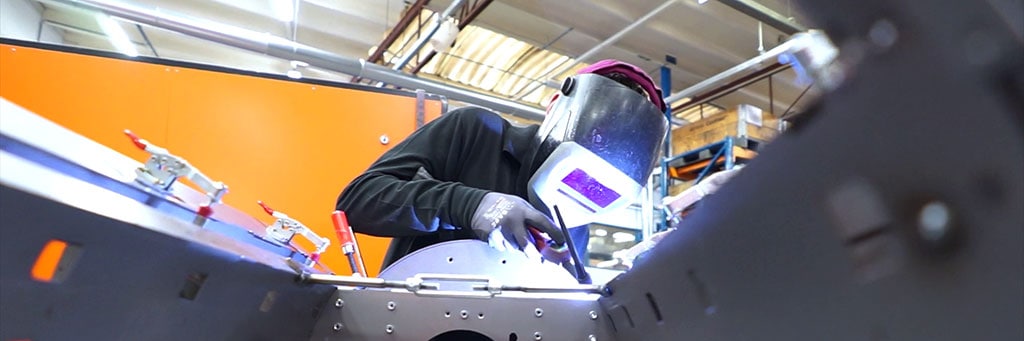
Spot welding
Spot welding is a welding process that we mainly use to join components made of thin sheet metal.
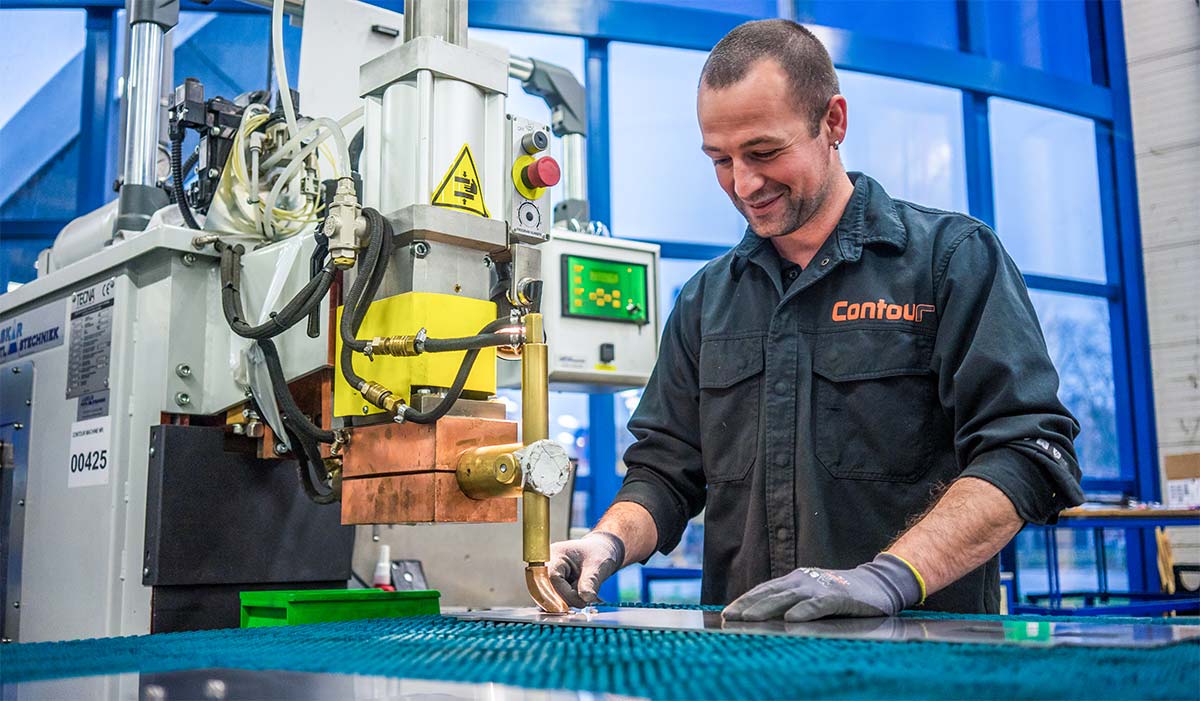
In spot welding, the metal sheets to be welded are clamped between two electrodes under high pressure. An electric current with a high amperage runs between the electrodes and briefly heats the sheet metal. The sheet parts melt together, creating a strong and stable joint. To prevent the electrodes from fusing with the product, Contour cools the electrodes with water.
At Contour we use several spot welding machines. Each machine has a brush bed so that we can work with minimal scratching. Our experienced operators can set the spot welding machines so that the bond between the products is strong, while the distortion and marking caused by the heat input are minimized.
Are you looking for a supplier for your sheet metal parts assembled with a spot weld joint? Request a quote right away!
+31 (0)543 54 67 89 Request a quote
Advantages of spot welding
- Speed: First, the high currents make it possible to reach a high temperature at the weld location in a short time. This leads to fast welding speeds and high productivity.
- Clean: The short welding process has the added advantage that the surface is unlikely to oxidize, so shielding gas is not needed.
- Material variety: Spot welding can also be used for a wide range of materials. Materials we process include stainless steel, steel, aluminum, and galvanized steel.
- Fasteners: With our spot welding machines it is also possible to weld various fasteners, such as weld nuts and bolts, onto sheet metal.
- Thickness variety: With the right settings, electrode, and experience, sheets of widely different thicknesses can be joined. For example, we have experience joining 3 mm sheet to 6 mm sheet.
- Requirements: Spot welding is a relatively simple welding process because no filler material is needed to make the joint.
Field of application
Spot welding is mainly used for welding thin sheet materials with thicknesses between 0.5 and 6 mm. The welding process is suitable for a wide range of materials, including steel, stainless steel, aluminum, and galvanized metal.
Spot welding can be used for welding overlapping sheets, but is less suitable for non-overlapping sheets where the end faces of the material have to be joined. For thin materials we use TIG welding for this.
Although spot welding has several advantages, it also has some disadvantages. Because of the geometry of the spot welding machine and the product, the electrodes cannot be positioned at every conceivable location. In addition, the strength of the weld joint is lower than with some other welding processes, because welding takes place only on small areas. No weld is made along the entire length of the joint. Other welding processes can do this.