

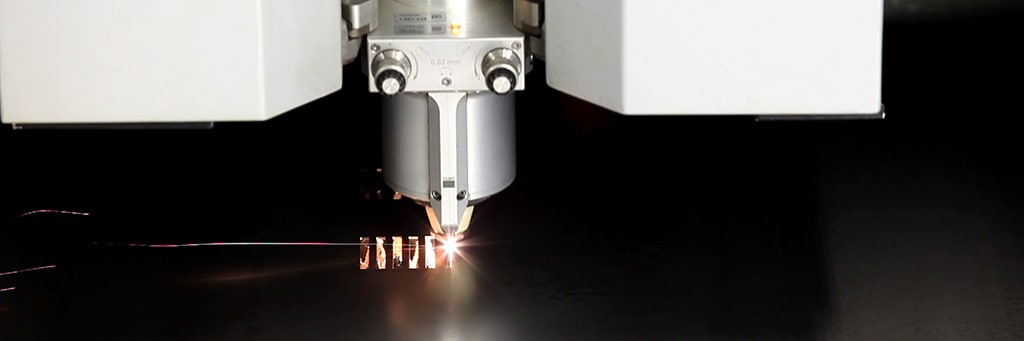
Laser & fiber laser
The rise of laser technology has been decisive for the sheet metal industry. Almost any desired contour can be cut from sheet material with the laser. Together with CNC control, so-called soft tooling became possible: cutting without product-specific tooling. In the past, custom punching tools were often used for this, also called hard tooling.
In modern sheet metal fabrication, the solid-state laser, usually called fiber laser in practice, has become the standard for laser cutting of sheet metal. But what makes the laser so suitable as a separation technique for sheet metal fabrication, and what is the difference between a CO2 laser and a fiber laser? On this page we explain the technology and outline what the current generation of laser cutting machines makes possible.
What is a laser?
Laser is a form of electromagnetic radiation. Laser sources can produce ultraviolet, visible or infrared light. When cutting metal, mainly infrared is used: solid-state laser sources around 1 µm and CO2 laser sources around 10.6 µm. This laser light is not visible to the human eye, but it is still commonly called “light”.
The term “laser” originated as an English acronym: Light Amplification by Stimulated Emission of Radiation.
A combination of three properties makes laser light particularly suitable for cutting metal:
-
1
Laser light is monochromatic: light of only one uniform wavelength (color) is generated.
-
2
Laser light is coherent: all light waves are in phase and run in sync with each other.
-
3
Laser light is directional: the light is generated in a narrow, focused beam. Unlike an incandescent bulb, it does not spread in all directions around the light source.
How does laser cutting work?
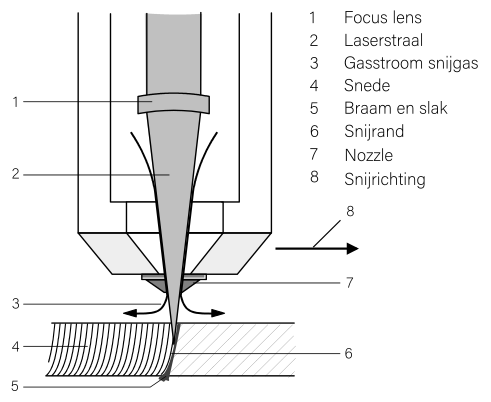
Because laser light is directional and hardly diverges, a lens can focus it sharply onto a very small spot. At that focal point the power density is enormous.
At high power, the material at that spot is heated so strongly that it melts or vaporizes. The molten material is then blown out of the kerf under high pressure with a cutting gas. Moving the laser beam across the sheet creates a cutting line. This is the working principle of laser cutting.
This technique has a number of strong advantages for sheet metal fabrication:
- Contactless cutting, without mechanical force on the workpiece.
- Almost any 2D contour without product-specific tooling (soft tooling).
- High accuracy and excellent repeatability.
- A narrow kerf with limited heat input into the material.
- High cutting speed, especially with thinner sheet thicknesses.
CO2 laser versus fiber laser
Two families of laser sources are distinguished for laser cutting of sheet metal: the CO2 laser and the solid-state laser. In sheet metal fabrication, “fiber laser” is often used as a collective name for a solid-state laser around 1 µm whose beam travels to the cutting head through a fiber optic cable.
It helps to distinguish between the machine builder and the laser source. In European sheet metal companies you see many machines from, among others, Trumpf, Bystronic, Amada, LVD, Eagle, Mazak and Mitsubishi. The source or oscillator in such a machine can be supplied by the machine builder itself, or by a specialized source manufacturer such as IPG, Coherent, nLIGHT, FANUC, Raycus or max Photonics. At Trumpf the source is often part of the company’s own ecosystem, such as TruDisk or TruFiber.
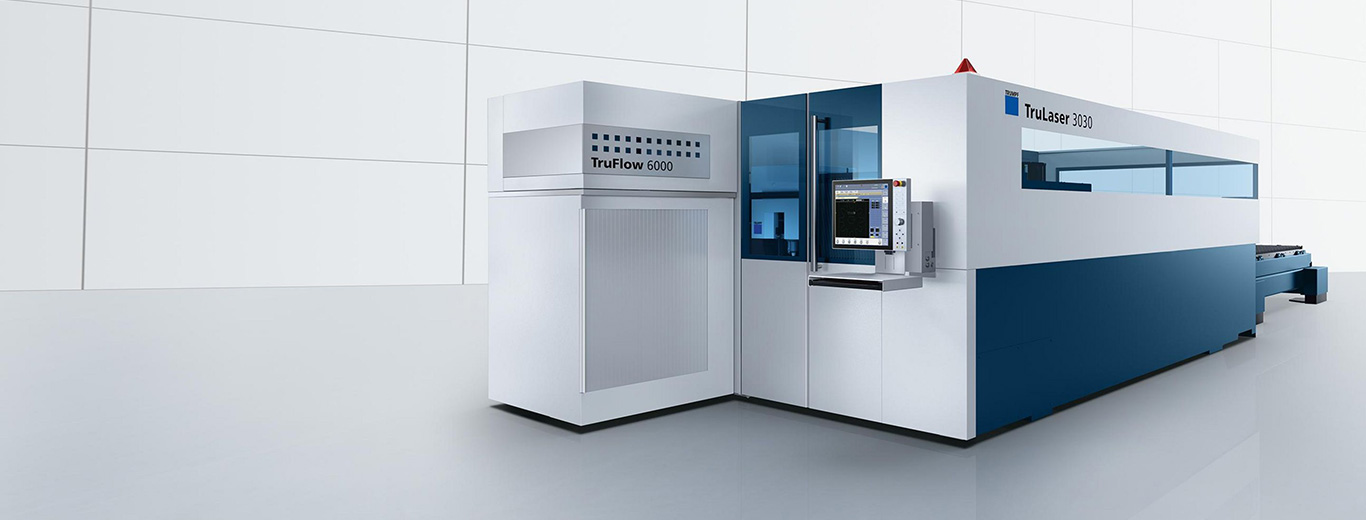
At Contour we cut with a Trumpf solid-state laser: in these TruLaser machines the laser light comes from a disk laser (TruDisk), which is connected to the cutting head by a replaceable fiber optic cable. Since the mid-2010s, the solid-state laser has largely taken over the market for sheet metal. New CO2 installations for flatbed sheet laser cutting are now only installed to a limited extent; CO2 mainly retains its value for materials such as plastic, wood and some specialist applications.
Wavelength and absorption
What matters in laser cutting is that the material absorbs the laser radiation. Only absorbed radiation heats the material so that it melts. Radiation that is reflected (mirror) or passes through the material leaves the workpiece unaffected.
The wavelength (color) of the radiation largely determines how much a material absorbs, and that wavelength differs per type of laser source. A solid-state laser works with a wavelength around 1 µm: a disk laser at approximately 1,030 nm and a fiber laser usually between 1,060 and 1,080 nm. That small difference comes from the active medium: a ytterbium-doped YAG disk in the disk laser versus a ytterbium-doped optical fiber in the fiber laser. A CO2 laser emits radiation with a wavelength of 10,600 nm (10.6 µm), about a factor of ten longer.
As a rule of thumb: the shorter the wavelength in the infrared, the better metal absorbs the radiation. The shorter wavelength of the solid-state laser is absorbed better by common sheet metals such as steel, stainless steel, aluminum and copper alloys than the long CO2 wavelength. Actual absorption depends on surface, angle of incidence and temperature; as soon as the material melts or forms a keyhole, the coupling of laser energy increases further. In practice, a solid-state laser therefore cuts faster, especially in thin and medium-thick sheet, and processes reflective metals that are difficult or risky for a CO2 laser.
Advantages of the solid-state laser in practice
The solid-state laser, as a disk laser or fiber laser, has set the standard for sheet metal fabrication for several reasons:
- Higher energy efficiency. Modern solid-state sources convert a larger share of the electrical energy into laser power than CO2 sources. The exact consumption depends on power, cooling, cutting gas, machine configuration and nesting, but at machine level the solid-state laser is generally clearly more energy efficient.
- Beam delivery through optical fiber. The beam is brought to the cutting head through a flexible fiber optic cable (laser light cable), instead of through a system of carefully aligned mirrors as with a CO2 laser.
- Lighter, faster optics. As a result, the flying optics can be built lighter and the cutting head moves across the sheet at higher speed. With thin sheet this can be several times faster than with a CO2 laser.
- Simpler and low maintenance. The laser source contains fewer parts, needs no laser gas mixture and requires no mirror alignment.
- Reflective metals. Materials such as copper, brass and aluminum can be cut when the laser source, optics and process monitoring are suited to back reflection.
Cut quality: CO2 versus modern solid-state laser
For a long time the CO2 laser was the reference for the highest cut quality: at greater material thicknesses the cut edge of a CO2 cut was often smoother. With the most modern laser cutting machines this difference has shrunk considerably in most sheet metal applications. Thanks to beam shaping technology, for example Trumpf BrightLine fiber, nLIGHT Corona and Coherent HighLight FL-ARM, the power distribution of a solid-state laser can be adapted to material and sheet thickness. As a result, the modern solid-state laser combines high productivity with an industrially clean cut edge, also in thicker sheet. CO2 remains relevant only for special materials or exceptionally thick sheet with particular quality requirements.
Safety and enclosure
The wavelength also determines the safety risk. The near-infrared radiation of a fiber laser (~1 µm) penetrates to the retina and is strongly reflected by metal. That is why fiber laser machines are fully enclosed (laser class 1). The longer CO2 wavelength (10.6 µm), on the other hand, is absorbed at the surface of the eye, in the cornea, and is reflected back less dangerously. With older, open CO2 machines, a brush around the cutting head was enough as shielding. Modern machines, however, are fully enclosed as standard.
Reflective metals: copper and brass
Copper, brass and aluminum strongly reflect infrared radiation. At room temperature copper absorbs only a small part of 1-µm radiation; after melt and keyhole form, absorption increases. Even so, a modern solid-state laser cuts these materials well. This is due to the high power density at the focal point, process parameters for non-ferrous metals, and source and optics protection against back reflection. A CO2 laser could hardly process copper safely: the reflected beam could damage the resonator and mirrors.
Green laser sources around 515 nm and blue diode sources around 450 nm are industrially available, mainly for copper welding, battery applications and electronics. Copper absorbs green light at room temperature much better than near-infrared light. For standard 2D sheet laser cutting, however, these wavelengths are in practice not a replacement for the 1-µm solid-state laser; they are mainly relevant in special copper processes.
Industrial solid-state laser sources in modern production
The common laser sources in production environments are not lab setups, but robust high-power sources built into cutting machines, robot cells and automated lines. In the European sheet metal industry, the brand on the machine is often better known than the brand on the source. In its own flatbed machines Trumpf generally uses its own sources such as TruDisk and TruFiber. Amada and Mitsubishi usually supply their fiber lasers as their own machine and oscillator package. Machine builders such as Bystronic, LVD, Eagle and other European OEMs more often have a source from a specialized supplier in the machine. In practice you mainly come across IPG Photonics, alongside sources from, among others, Coherent, nLIGHT, FANUC, Raycus and max Photonics. Which source exactly is used depends on machine generation, power, optics configuration and market.
The difference between modern sources lies less and less in the number of kilowatts alone. Beam shaping, power stability, back reflection protection, cutting head monitoring, automatic focus and nozzle adjustment, and software-based process databases determine in practice at least as strongly whether a machine can produce reliably and unattended.
Materials and sheet thicknesses
A modern solid-state laser processes almost all common sheet metals, from thin sheet to thick plate. The maximum sheet thickness depends on the available laser power, the beam quality, the cutting head, the cutting gas used, the process package and the required edge quality. Thin sheet around 0.5 mm is normal laser work; with high-end flatbed machines with powers above 12 kW the maximum cutting thicknesses are much higher. The values below are indicative ranges and upper limits for modern fiber lasers on the market, not a fixed Contour specification:
| Material | Indicative cutting thickness | Note |
|---|---|---|
| Structural steel S235 / S355 | approx. 0.5 to 40 mm, up to 60 mm with thick plate package | The greatest thicknesses require a lot of power, the right optics and often special process settings. |
| Stainless steel 304 / 316 | approx. 0.5 to 40 mm, up to 60 mm with thick plate package | Usually with nitrogen for an oxide-free cut edge; thick stainless steel requires a lot of gas and stable settings. |
| Aluminum | approx. 0.5 to 40 mm | Reflective and heat conducting; requires stable process settings. |
| Copper | thin sheet up to approx. 16 mm | Only with a suitable solid-state source and back reflection protection. |
| Brass | thin sheet up to approx. 12.7 mm | Similarly critical due to reflection and heat conduction. |
The greatest thicknesses depend on the manufacturer and machine and do not automatically apply to every quality requirement or every production situation. Feel free to contact us for the current Contour specifications.
Cut quality, tolerances and post-processing
Laser cutting produces a narrow kerf with limited heat input and tight tolerances. The achievable dimensional accuracy depends on sheet thickness, material and machine, but for thin sheet it is generally within a few tenths of a millimeter. A slight burr or oxide skin may remain on the cut edge.
Where necessary, the product is reworked by deburring and edge rounding. After cutting, further operations often follow, such as bending (press braking), punching and welding, so that a complete sheet metal product results.
Automation and modern laser cutting
Laser cutting is ideally suited to extensive automation. Modern installations combine the cutting machine with automatic loading and unloading, storage towers and software for nesting and planning. This allows unattended production to continue, also 24/7 and lights-out. At Contour, laser cutting runs fully automatically, 24 hours a day, with automatic loading and unloading.
The main developments at a glance:
- High powers. Solid-state sources above 20 kW in high-end flatbed machines enable higher cutting speeds and greater material thicknesses.
- Beam shaping. Technology such as Trumpf BrightLine fiber adapts the laser beam to each material and thickness for optimal quality.
- Smart process management. Sensor and camera monitoring and AI support monitor the cutting process and shorten setup time.
- Unattended operation. Automatic nozzle change and calibration increase the reliability of lights-out production.
- New wavelengths. Green and blue industrial laser sources mainly improve copper welding and battery applications; for standard 2D cutting the 1-µm solid-state laser remains the norm.
- More than flat sheet. Besides 2D sheet, cutting is also done with a bevel, and there is a close link with tube laser cutting.
Frequently asked questions about laser cutting
What is the difference between a CO2 laser and a fiber laser?
Both are laser sources for cutting sheet metal, but they differ mainly in wavelength. A solid-state laser works around 1 µm (a disk laser at approximately 1,030 nm, a fiber laser at approximately 1,070 nm) and a CO2 laser at 10,600 nm. The shorter wavelength of the solid-state laser is absorbed better by metal, is more energy efficient, faster and guides the beam through optical fiber. The solid-state laser (commonly called “fiber laser”) has therefore become the standard for sheet metal fabrication.
Which materials can be laser cut?
Almost all common sheet metals: structural steel, stainless steel, aluminum and, with a fiber laser, also reflective metals such as copper and brass.
What sheet thickness can a laser cut?
That depends on material, laser power, cutting gas and required edge quality. Modern fiber lasers cut thin sheet, often around 0.5 mm, but high-end machines go much thicker: up to approximately 60 mm for structural steel and stainless steel with a thick plate package, up to approximately 40 mm for aluminum, approximately 16 mm for copper and approximately 12.7 mm for brass. These are machine-dependent maximums, not a fixed Contour specification.
Which cutting gas does Contour use for laser cutting?
Contour cuts exclusively with nitrogen, for a clean, oxide-free cut edge that can be painted and welded directly. Read more on the page cutting gases in laser cutting.
Is a fiber laser better than a CO2 laser?
For cutting sheet metal, in almost all cases yes: the solid-state laser is faster, more energy efficient and can process reflective metals. Thanks to beam shaping, the cut quality approaches or equals that of CO2 in many applications. CO2 mainly retains a role for non-metals and some specialist niches.