From pioneering work in the 1980s to revolutionary precision and automation: laser cutting through the years!
In the early 1980s, CNC laser cutting of sheet metal was still in its infancy. It was a revolutionary production method that followed shortly after CNC punching.
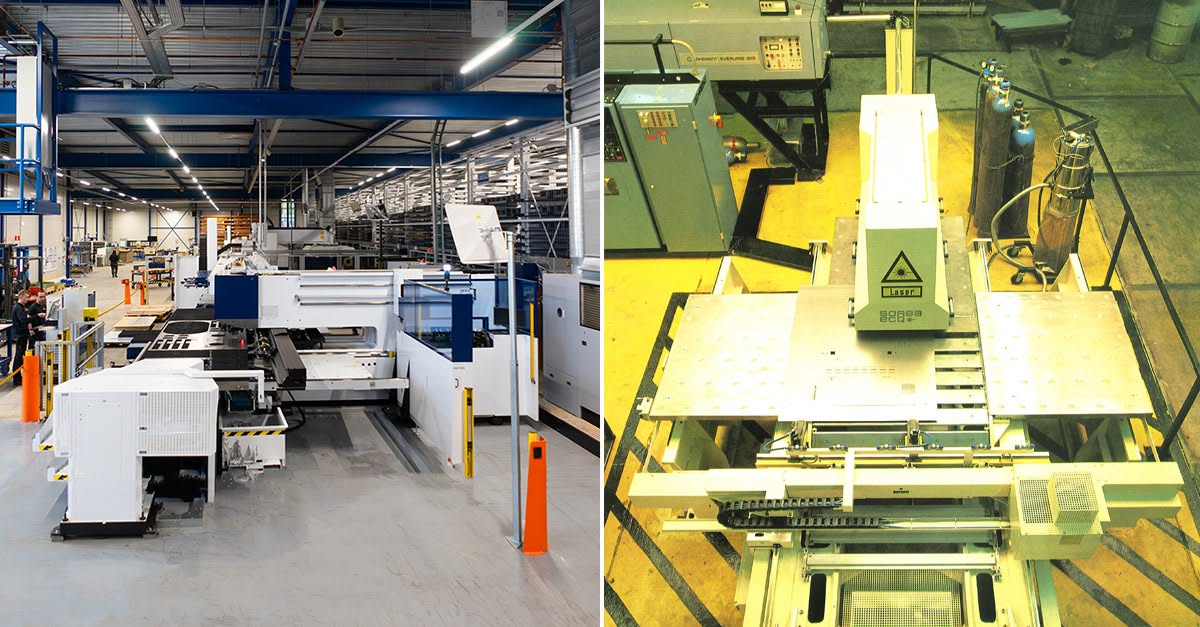
Contour (then Sorba Precisieplaatwerk) acquired the Behrens Bel-cut laser cutting machine in 1981, equipped with a Coherent Everlase 325 laser source from England. It was one of the very first laser cutting machines in Europe. This innovative laser source consisted of an oil-cooled tube no less than four meters long, with an output of about 500 W. For efficient operation, the system first had to warm up properly in the morning. Control came from a General Electric system from the US, while the cutting table was made by Behrens.
As the second company in the world with a CNC laser cutting machine using this Coherent source, Contour was a pioneer in the sector. Only one company in California had implemented the Coherent laser source before. The Coherent source was later upgraded to a Rofin Sinar 1200 W CO2 laser with a Roots pump. Notably, the machine carried its own addition, “ECQ”, which stood for Enhanced Cutting Quality.
Today, Contour remains a leading company in sheet metal parts and has invested in the most modern technologies. We have two Trumpf TruMatic TM7000 punch-laser combination machines, which can both punch and laser cut. Contour also has a 3030L flatbed laser machine.
What sets these modern machines apart is their precision and fully automatic operation. Linked to an FMS line (a fully automated storage system), they can produce “lights-out” without human intervention. That still takes a good dose of craftsmanship: the machines and tools must be set up carefully and the programs must be stable.
In the FMS line, the material is retrieved from storage automatically and delivered to the machines. After cutting, the cut parts are returned to storage, so they are immediately available for the next operations.